
Research series · Issue 01 · September 14, 2026
Moving AI from Pilots into Enterprise Workflows
The model usually works. The workflow around it is what breaks. A field guide to ownership, data, security, review, and cost.
By Megan Dahlgren · For enterprise IT practitioners
At a glance
Moving AI from pilot to production means managing everything between a request and a verified business outcome. A model can read a ticket perfectly and the service can still fail because of stale data, wrong permissions, or an update nobody can confirm.
88% → 7%
use AI in at least one function — vs. have fully scaled it
McKinsey global survey, 2025
40%
faster feature delivery at Doctolib
Anthropic, 2026 · vendor-reported
70–75%
of variable running cost is human oversight — not the model
McKinsey banking example, 2026
Five things that break — and what to decide
- 01The workflow boundaryWhere does the AI's job start and end — and who owns the whole path?
- 02Data accessWhich source is authoritative, what may AI write, and who checks?
- 03SecurityWhich tools, with which permissions?
- 04Human reviewHow much review and oversight can this agentic workflow justify?
- 05EconomicsWhat is the total cost to regularly deliver this agentic outcome?
The bottom line
Give each workflow a business owner and a service owner, define what AI agents may read and change, and value the business outcomes in dollar terms before release. Expand only when a workflow meets its quality bar at an acceptable cost.
From the report
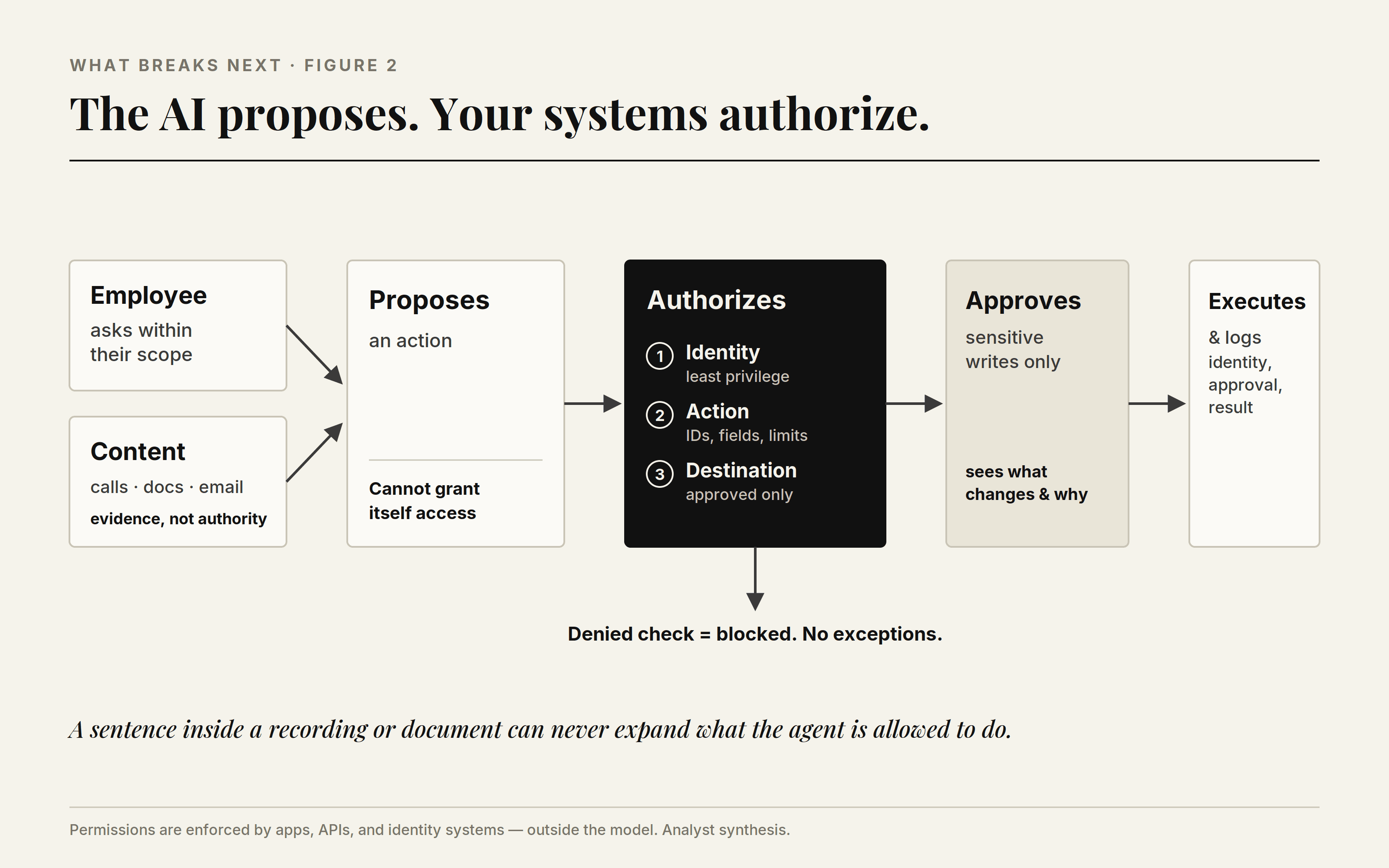
Keep permission to act outside the model.
Every tool you add changes what an AI agent can reach and what damage it can cause. When permissions live in the surrounding system instead of the model’s judgment, a hijacked prompt can ask for the keys — but the system won’t hand them over.
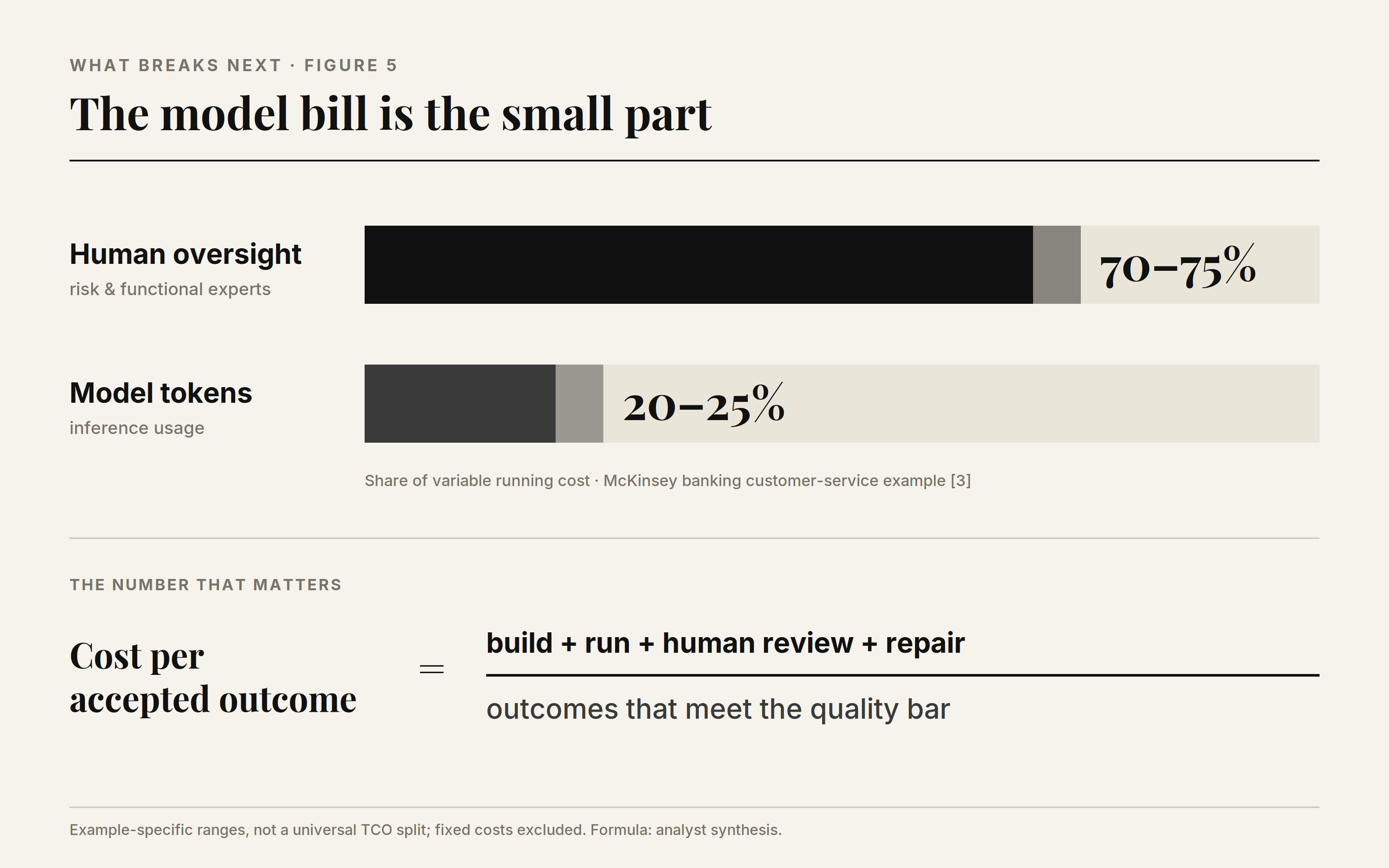
Speed isn’t savings.
In McKinsey’s banking customer-service example, human oversight is 70–75% of variable running cost; model tokens are 20–25%. Build the business case around a completed outcome, and measure cost per accepted outcome — including review and repair.
Five decisions before you scale
- 1
Name two owners.
A business owner for the outcome; a service owner for the running system.
- 2
Write the permission map.
What the AI may read, what it may change, and what needs a human.
- 3
Test outcomes, not answers.
Agree which failures block release before you start testing.
- 4
Rehearse the stop.
Security, ITSM, engineering, and compliance agree how to detect, suspend, and restore — and practice it.
- 5
Price the whole job.
Staff the review queue. Measure cost per accepted outcome, including repair.
Also inside the full report
- The pilot that broke scaling to production — a service-desk scenario
- Morgan Stanley: a bounded design that reached 98% adoption
- Gong: one data tool, three governance lessons
- The lethal trifecta, and an AI-sandbox attack traced through the controls
- Which governance frameworks to use for which job
- Where the running cost of an AI workflow actually goes
We want to hear from you
What failed after your rollout?
Our next phase of research examines the transition with practitioners: what failed after rollout, what teams changed, and whether the gains held up. If you’re bringing AI into production, we’d like to include your perspective.
Join the researchWorking on one of these problems?
Turn the research into a decision.
Mesa works with AI infrastructure companies and investors to test enterprise demand, sharpen positioning and find the first credible use case.
Discuss a Mesa engagementGet the next report
Next in the series: What Breaks Next for the CIO, the CTO, the Chief Data Officer, the Chief AI Officer and the CISO. We’ll email each one as it’s published.